Showing posts with label biographical. Show all posts
Showing posts with label biographical. Show all posts
Thursday, 24 September 2015
I was born
I was born with the umbilical chord wrapped around my neck. If I had died when I was born then I wouldn't have had this fucking amazing weird, terrifying, exhilarating, frustrating, educational, unspeakable, paradoxical life. So I am grateful to be alive. Thank you.

Monday, 5 November 2012
Do I know you?
-->
by Antony
Sammeroff
A scratch night play in one act for one actor and one actress.
A scratch night play in one act for one actor and one actress.
Do I know
you?
April and Anthony enter from opposite sides
of the stage as they draw close they catch eyes and think they know each other
immediately, but then a moment of doubt creeps in.
ANTONY [with enthusiasm]. Hey!
APRIL [responding in kind]. Hey!
There is a moment of credulity
ANTONY [communicating with his hands]. I thought we…?
APRIL. I thought we…
ANTONY. But we don’t.
APRIL. No, we don’t…
ANTONY. Well I’m Antony. [He presents his hand]
APRIL. I’m April…
They shake.
ANTONY. So next time we will.
He smiles.
APRIL. Next time we will.
They part.
ANTONY [with enthusiasm]. Hey!
APRIL [responding in kind]. Hey!
There is a moment of credulity
ANTONY [communicating with his hands]. I thought we…?
APRIL. I thought we…
ANTONY. But we don’t.
APRIL. No, we don’t…
ANTONY. Well I’m Antony. [He presents his hand]
APRIL. I’m April…
They shake.
ANTONY. So next time we will.
He smiles.
APRIL. Next time we will.
They part.
Tuesday, 30 October 2012
Preliminary thoughts for my dissertation
On some level we want to say that the great compositions
of, say, Beethoven are in some way 'better' than those of say, Katy
Perry whom we had a look at in MMA last year with Martin Dixon
(if you happen to think she's a great contemporary composer you may substitute some other name which fits the bill of simply composed/kitsch music.)
On one hand it's hard to say that it's an objective judgement of quality, because all aesthetic experiences fall into the subjective experience of the person receiving them. On the other hand we know we are making a distinction between we say music is 'bad' music versus music which is 'not my kind of thing.'
Personally I hate swing music. Despite liking something in almost every genre of music I've never been able to cultivate a taste for Swing. But I'm not willing to turn around and say that Quincy Jones was a ‘bad’ arranger when working with Frank Sinatra - he's clearly extremely competent. I just personally don’t like it.
On Sunday night I heard two folk singers sing a song together where each of their parts was incredibly sophisticated with little riffs and inventive harmonies – I was impressed by the counterpoint because I thought (“knew”?) it was qualitatively 'better' than if they'd just harmonised in thirds. Not that harmonising in thirds would be “bad” or “unpleasant” – I just felt like what I was hearing was superior.
While the lay patron could also notice a difference in complexity and might likely agree that the more sophisticated, sung by more practiced singers, was the “better”, it seems I've cultivated a taste that allows me to make more complicated value judgements than non-musicians. I can make a distinction here between say, Burt Bacharach, the composer of great pop tunes, and Burt Bacharach the extremely competent and innovative arranger/composer whose use of complex rhythmical phrasing which was rare in pop music, expressive chord changes and ingenious sequences tantalise my ear as a musician.
This impulse may sometimes lead those of us who know a bit about music hear a song and think - "that would be better if only..." [it included such and such an obviously missing vocal harmony, or they chose this note or that chord instead of the one, or they took] ...
What are we saying? We're not just saying we'd prefer it, we're arguing that we have a qualified opinion on what would improve the piece of music.
But improve the music how? And to what ends? Is it because the pleasure of enjoying more sophisticated music is greater than enjoying pop on the cosmetic level?
As a theatre critic I have to make value judgments and try to offer feedback, which is hopefully useful - either to the company or the patrons. Both if possible. ("I particularly like the ones which, from beneath the veil of the plot, reveal to the experienced eye some subtle truth that will escape the common herd," - Voltaire in The White Bull.) I have no doubt that the highest achievement the critic can manage is to point out some subtlety of genius that escapes 'the common herd' so that when they read my writing they have an “Ah!” moment – “Oh my god that is so true/observant.” This act of enlightenment forever changes the viewer and opens their eyes to watching out for similar phenomena in future aesthetic experiences. Their taste is more cultivated. Their standards have been permanently raised.
When it comes to giving negative criticism, much of what I write is all but ubiquitously noted by the audience, the lay person may notice and cringe. At other times I notice things most do not, but as far as I’m concerned they are extremely important, perhaps to the fidelity of the writing. A common example is that often the actors have not sufficiently noted what is said about their character by other characters in the script, and disregarded these hint in their portrayal. Such things may often escape the regular theatre goer because an actor’s performance can be internally consistent without while making this error, so in this way having a cultivated taste could be seen as a liability when it comes to gaining pleasure from an aesthetic experience. Then what nonsense does this make of striving to enlighten people just do they can enjoy theatre less? Surely we want them to enjoy poor theatre less so that they can enjoy good theatre more.
The companies may appreciate such feedback because they want to be 'better' - they appreciate there is somewhere to go. If not what would be the point in improving? Why strive to be capable of a Goldberg variation when any pleasant sounding two-part invention will do?
And then, sophistication isn’t synonymous with quality either. We often also appreciate “the beauty of simplicity.”
What is more, if some of the modernists are to be believed, pleasure is not necessarily even the critical point of the aesthetic experience.
I recall Martin Dixon saying, 'Is that all you want from music?' - paraphrasing the essential sentiment of Adorno as he did
My response is to say, as a thinker living in post-modern times, “may many flowers bloom.” Perhaps pleasure is not the critical point of the aesthetic experience in some cases, and in other cases it is.
While I could never “cultivate” a taste for swing, I once had no taste for Opera but developed a love for it. Most peoples experience of Schoenberg or, "worse still", the more impenetrable moderns is that some study plus considerable exposure is required to "get it".
Adorno commented on the relevance of the techniques used to the music at hand (I will cite an example in my essay most likely as I remember reading him comment on such and such a chord in chamber music being appropriate, but not in such and such another genre.) In this observation he is not alone. His remarks are actually very mainstream: in contemporary times the synths so synonymous with 80s pop music sound disastrously “cheesy” except in pastiche. The “choir” or “harpsichord” settings on your keyboard, anathema to a hard rock band, sounds perfectly appropriate and apt in the European “Viking” or “Gothic” metal genres. Simon Frith, in his essay on “bad music” refers to the kind of “genre confusion” involved with “getting this wrong” as ‘ridiculous music… the gap between what performers/producers think they are doing and what they actually achieve.” Certainly this makes a credible argument for calling music bad that does not draw upon the sophistication of the material – music can be both sophisticated technically and “bad” or “cheesy.”
Adorno’s argument that immanence through self-reference makes music better is extremely compelling, and yet it seems to be presented as self-evident and without argument, which makes it difficult to justify in under the Western analytic tradition. That is the problem I will face if I wish to make use of any of Adorno’s arguments for what is good or bad in music.
(if you happen to think she's a great contemporary composer you may substitute some other name which fits the bill of simply composed/kitsch music.)
On one hand it's hard to say that it's an objective judgement of quality, because all aesthetic experiences fall into the subjective experience of the person receiving them. On the other hand we know we are making a distinction between we say music is 'bad' music versus music which is 'not my kind of thing.'
Personally I hate swing music. Despite liking something in almost every genre of music I've never been able to cultivate a taste for Swing. But I'm not willing to turn around and say that Quincy Jones was a ‘bad’ arranger when working with Frank Sinatra - he's clearly extremely competent. I just personally don’t like it.
On Sunday night I heard two folk singers sing a song together where each of their parts was incredibly sophisticated with little riffs and inventive harmonies – I was impressed by the counterpoint because I thought (“knew”?) it was qualitatively 'better' than if they'd just harmonised in thirds. Not that harmonising in thirds would be “bad” or “unpleasant” – I just felt like what I was hearing was superior.
While the lay patron could also notice a difference in complexity and might likely agree that the more sophisticated, sung by more practiced singers, was the “better”, it seems I've cultivated a taste that allows me to make more complicated value judgements than non-musicians. I can make a distinction here between say, Burt Bacharach, the composer of great pop tunes, and Burt Bacharach the extremely competent and innovative arranger/composer whose use of complex rhythmical phrasing which was rare in pop music, expressive chord changes and ingenious sequences tantalise my ear as a musician.
This impulse may sometimes lead those of us who know a bit about music hear a song and think - "that would be better if only..." [it included such and such an obviously missing vocal harmony, or they chose this note or that chord instead of the one, or they took] ...
What are we saying? We're not just saying we'd prefer it, we're arguing that we have a qualified opinion on what would improve the piece of music.
But improve the music how? And to what ends? Is it because the pleasure of enjoying more sophisticated music is greater than enjoying pop on the cosmetic level?
As a theatre critic I have to make value judgments and try to offer feedback, which is hopefully useful - either to the company or the patrons. Both if possible. ("I particularly like the ones which, from beneath the veil of the plot, reveal to the experienced eye some subtle truth that will escape the common herd," - Voltaire in The White Bull.) I have no doubt that the highest achievement the critic can manage is to point out some subtlety of genius that escapes 'the common herd' so that when they read my writing they have an “Ah!” moment – “Oh my god that is so true/observant.” This act of enlightenment forever changes the viewer and opens their eyes to watching out for similar phenomena in future aesthetic experiences. Their taste is more cultivated. Their standards have been permanently raised.
When it comes to giving negative criticism, much of what I write is all but ubiquitously noted by the audience, the lay person may notice and cringe. At other times I notice things most do not, but as far as I’m concerned they are extremely important, perhaps to the fidelity of the writing. A common example is that often the actors have not sufficiently noted what is said about their character by other characters in the script, and disregarded these hint in their portrayal. Such things may often escape the regular theatre goer because an actor’s performance can be internally consistent without while making this error, so in this way having a cultivated taste could be seen as a liability when it comes to gaining pleasure from an aesthetic experience. Then what nonsense does this make of striving to enlighten people just do they can enjoy theatre less? Surely we want them to enjoy poor theatre less so that they can enjoy good theatre more.
The companies may appreciate such feedback because they want to be 'better' - they appreciate there is somewhere to go. If not what would be the point in improving? Why strive to be capable of a Goldberg variation when any pleasant sounding two-part invention will do?
And then, sophistication isn’t synonymous with quality either. We often also appreciate “the beauty of simplicity.”
What is more, if some of the modernists are to be believed, pleasure is not necessarily even the critical point of the aesthetic experience.
I recall Martin Dixon saying, 'Is that all you want from music?' - paraphrasing the essential sentiment of Adorno as he did
My response is to say, as a thinker living in post-modern times, “may many flowers bloom.” Perhaps pleasure is not the critical point of the aesthetic experience in some cases, and in other cases it is.
While I could never “cultivate” a taste for swing, I once had no taste for Opera but developed a love for it. Most peoples experience of Schoenberg or, "worse still", the more impenetrable moderns is that some study plus considerable exposure is required to "get it".
Adorno commented on the relevance of the techniques used to the music at hand (I will cite an example in my essay most likely as I remember reading him comment on such and such a chord in chamber music being appropriate, but not in such and such another genre.) In this observation he is not alone. His remarks are actually very mainstream: in contemporary times the synths so synonymous with 80s pop music sound disastrously “cheesy” except in pastiche. The “choir” or “harpsichord” settings on your keyboard, anathema to a hard rock band, sounds perfectly appropriate and apt in the European “Viking” or “Gothic” metal genres. Simon Frith, in his essay on “bad music” refers to the kind of “genre confusion” involved with “getting this wrong” as ‘ridiculous music… the gap between what performers/producers think they are doing and what they actually achieve.” Certainly this makes a credible argument for calling music bad that does not draw upon the sophistication of the material – music can be both sophisticated technically and “bad” or “cheesy.”
Adorno’s argument that immanence through self-reference makes music better is extremely compelling, and yet it seems to be presented as self-evident and without argument, which makes it difficult to justify in under the Western analytic tradition. That is the problem I will face if I wish to make use of any of Adorno’s arguments for what is good or bad in music.
Wednesday, 24 October 2012
eBay don't pay all their taxes? Good!
Here's an
interesting but controversial thought experiment.
In response to this article in the Guardian claiming that eBay has avoided some £50m in taxes, a friend of mine was asking around to see if there was any alternative she could use because she wanted to boycott them.
I asked her to expand on her reasons why, because I thought that the government would only spend the money on wars, corporate welfare, paying off the bankers and their cronies anyway, so what was the point?... She kindly responded:
"It would mean less of an excuse for austerity measures; if they're seen to be collecting the funds, and still cutting the welfare state. The government is very good at shifting the blame - but if places like Starbucks, IKEA, and eBay actually paid taxes, then the government has nowhere to hide."
My thought was that while those propositions may hold true in a socialist utopia, they are actually based on a basic misapprehension of economics which is quite common, particularly on the left, which is that it is actually possible for corporations to pay taxes. In truth, as the (very liberal) Senator, Mike Gravel, put in his book Citizen Power a Mandate for Change (2008) under the chapter which advocates for tax reform (in line the Fair Tax proposals):
"Liberals bristle at the thought of relieving corporations of income taxes. Unfortunately... fooled into thinking that by taxing corporations they shift the cost of government from the people to corporations. Corporations do not pay taxes; they merely collect taxes from their consumers for the government, In fact, a corporate tax is a disguised retail sales tax....
In response to this article in the Guardian claiming that eBay has avoided some £50m in taxes, a friend of mine was asking around to see if there was any alternative she could use because she wanted to boycott them.
I asked her to expand on her reasons why, because I thought that the government would only spend the money on wars, corporate welfare, paying off the bankers and their cronies anyway, so what was the point?... She kindly responded:
"It would mean less of an excuse for austerity measures; if they're seen to be collecting the funds, and still cutting the welfare state. The government is very good at shifting the blame - but if places like Starbucks, IKEA, and eBay actually paid taxes, then the government has nowhere to hide."
My thought was that while those propositions may hold true in a socialist utopia, they are actually based on a basic misapprehension of economics which is quite common, particularly on the left, which is that it is actually possible for corporations to pay taxes. In truth, as the (very liberal) Senator, Mike Gravel, put in his book Citizen Power a Mandate for Change (2008) under the chapter which advocates for tax reform (in line the Fair Tax proposals):
"Liberals bristle at the thought of relieving corporations of income taxes. Unfortunately... fooled into thinking that by taxing corporations they shift the cost of government from the people to corporations. Corporations do not pay taxes; they merely collect taxes from their consumers for the government, In fact, a corporate tax is a disguised retail sales tax....
...they
simply take the tax into account as an added cost of production… and adjust
their prices accordingly... close examination of the tangled corporate tax
structure shows it only serves to inflate the cost of goods and services to
consumers... Obviously, if we eliminated all corporate taxes and subsidies, the
ordinary tax payer would come out far ahead."
These words are not from a reactionary Republican or Thatcherite, but from one of the most liberal senators in the American political system, who became nationally known for his forceful but unsuccessful attempts to end the draft during the Vietnam War and for putting the Pentagon Papers into the public record in 1971 at risk to himself, and then throughout his career campaigned for direct democracy, an end to war, transparency in government, universal healthcare, social security, and all the other trappings of a left-of-centre Democrat.
These words are not from a reactionary Republican or Thatcherite, but from one of the most liberal senators in the American political system, who became nationally known for his forceful but unsuccessful attempts to end the draft during the Vietnam War and for putting the Pentagon Papers into the public record in 1971 at risk to himself, and then throughout his career campaigned for direct democracy, an end to war, transparency in government, universal healthcare, social security, and all the other trappings of a left-of-centre Democrat.
That might be pretty hard to apprehend because it arouses our sense of
injustice that the big boys can get around paying while small business owners
and the rest of us tax cattle have to put in for stuff we don’t agree with
(like the wars) but perhaps once we realise that this tax money is not being
extracted from the bank accounts of rich CEOs, but us independent eBay users the
case may becomes clear. We foot the bill.
Rich
people don’t pay income tax the same way we do. They have these handy things
called corporations. Private individuals earn, get taxed and live off what is
left. Corporations earn, spend, and are taxed on what it’s left, check out this
handy diagram from Rich Dad, Poor Dad
(2000) Robert T. Kiyosaki:
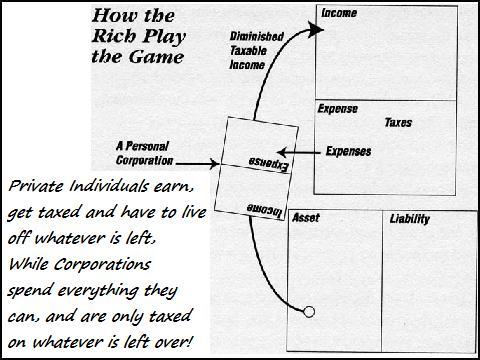
Remember, the status of “Corporation” is a privilege granted to certain
companies by the state rather than the
free market. If you
wanted to tax the receipts of "greedy capitalists" the option would
be to place tax on share dividends, although perhaps even those could craftily
be passed on to the consumer.
The truth
is, if eBay were forced to pay their taxes, all that would likely happen is
that they’d raise the price of listing products. The cost will be passed on to
the consumer and be borne by buyers and sellers. It's certainly very unlikely
to do any good in the world.
eBay is one of the biggest employers in the world, allowing around 350,000 people to work from home and have more leisure time. It facilitates recycling and ends wastage by putting people who want second hand products in touch with people who have those products and no longer need them. It even has a feedback system which allows people to indicate who is trust worthy to exchange with and who is not. There are punitive consequences for not honouring your word, much unlike in the political realm where those who don't keep campaign promises escape unscathed, and those guilty of far greater crimes and misdemeanours under the guise of foreign policy (or even domestic policy) seem to walk above the law.
eBay is one of the biggest employers in the world, allowing around 350,000 people to work from home and have more leisure time. It facilitates recycling and ends wastage by putting people who want second hand products in touch with people who have those products and no longer need them. It even has a feedback system which allows people to indicate who is trust worthy to exchange with and who is not. There are punitive consequences for not honouring your word, much unlike in the political realm where those who don't keep campaign promises escape unscathed, and those guilty of far greater crimes and misdemeanours under the guise of foreign policy (or even domestic policy) seem to walk above the law.
eBay enriches
the lives of millions of people, allowing them to afford things they couldn't
otherwise or make a bit of money on the side instead of chucking things out.
To
clarify the point, if we are talking about McDonald's who, we’ve been told, cut
down the rainforest, or Coca Cola who are said to monopolise, discriminate and
poison, or British Gas who are part of a state-granted cartel of the energy
industry which continues to increase prices while enjoying higher profits, to
the detriment of elderly customers who may freeze to death this winter... If
such a company is dodging taxes, by all means go ahead, boycott them. I'd
boycott them anyway on a moral principle, perhaps it will make them less
competitive.
But eBay? eBay isn't only harmless, it's is a credit to society.
But eBay? eBay isn't only harmless, it's is a credit to society.
The state, on the other hand, is a non-voluntary institution which institutes corporate monopolies by regulating into place barriers to entry. It makes war, kills more people than all private individuals and corporations put together, provides corporate welfare to the rich, makes nuclear weapons, sells arms to foreign dictators and subsidises nuclear and unsustainable energy despite the risks. It forces people at gun point to pay for indoctrination camps where their children are forced to do what they are told when they are told, habituating them to living in a hierarchical society before they ever enter the work place, and then after 11-13 years of this state-led ‘education’ most come out with so few skills that are economically valuable that they cannot even find minimum wage job. It puts people in cages with violent criminals and rapists if they happen to have the wrong kind of vegetation in their pocket, and at great expense to the tax payer, despite all the reason and evidence showing that drug prohibition has never worked, does not work, will never work - that addiction should be treated as a public health issue rather than a criminal one - and that those countries who have moved in the direction of legalisation or even decriminalisation have had the most positive outcomes. The state spent the younger generation into 1 trillion pounds of debt before they were even born by the act of buying votes from the older generation by giving them public services that they were not paying for themselves with their own tax money, and by printing money which inflated and devalued the currency to the benefit of the elite and detriment of the poor. And then on top of all that, as though that were not enough, they had the cheek to sell the tax payer further down the river by bailing out the bankers who were largely responsible for the economic crisis to the tune of £500 billion pounds in 2008.
The
government has the power to force you to pay for all these immoral things
whether you agree with them or not. Whether you like them or not. You are bound
to by law.
On the other hand, eBay can't force you to pay for a single thing your conscience disagrees with. Literally nothing. Ever.
On the other hand, eBay can't force you to pay for a single thing your conscience disagrees with. Literally nothing. Ever.
And I’m
supposed to believe that eBay dodging their taxes is the larger social issue at
stake here?
Supposing one of us were put in charge of a real life award of fifty million pounds.
Supposing one of us were put in charge of a real life award of fifty million pounds.
We were
told that the other judges had narrowed down the decision to two anonymous candidates,
and that they needed us to pick one of the two choices as a tie breaker.
All we
were given to base our decision on was a brief summary of what each of these bodies
had done, say, since eBay's inception in 1995. Those would include, on one side,
the wars and expenses scandals for example, and on the other side a charge of
infringing on patents (2000) and accusations of fleecing clients with an increase
in charges (2008) to name a couple. Could either of us honestly say, given all
the information in an essentially unbiased way - a way uncontaminated by the
social-bias which says paying taxes is virtuous by its very nature, while
avoiding them is necessarily vicious - that we would give the award to the more
violent party?
I'm pretty sure I know who I'd give the money to, if I happened to have the choice, and it wouldn't be the institution that had all the guns.
I'm pretty sure I know who I'd give the money to, if I happened to have the choice, and it wouldn't be the institution that had all the guns.
Tuesday, 23 October 2012
Why does the suffering of Animals matter?
Somebody asked me: Why does the suffering of animals matter?
I have to say I'm with Spinoza on this one. Nothing matters at all except in relation to someone or something else.
The universe really doesn't give a shit, it just goes on on it's very own course, in all it's beauty and all it's violence.
However, to the animal it matters more than anything in the world. They suffer a horrendous subjective experiences when we harm them.
I encourage people to be kind to animals, and not to pay other people keep them in horrid conditions then kill them just so they can enjoy eating them for twenty minutes or however long it takes to eat a meal. It seems such little luxury to exchange for so much suffering.
If you do eat animals maybe try to eat less of them or buy grass-fed ones who are reared in better conditions. It might not help you directly, but it will make the world of difference to some living creature who has feelings not that different from your own ♥ xXx
I have to say I'm with Spinoza on this one. Nothing matters at all except in relation to someone or something else.
The universe really doesn't give a shit, it just goes on on it's very own course, in all it's beauty and all it's violence.
However, to the animal it matters more than anything in the world. They suffer a horrendous subjective experiences when we harm them.
I encourage people to be kind to animals, and not to pay other people keep them in horrid conditions then kill them just so they can enjoy eating them for twenty minutes or however long it takes to eat a meal. It seems such little luxury to exchange for so much suffering.
If you do eat animals maybe try to eat less of them or buy grass-fed ones who are reared in better conditions. It might not help you directly, but it will make the world of difference to some living creature who has feelings not that different from your own ♥ xXx
Tuesday, 20 March 2012
If you want a life changing experience try living for a change...
I get up between eight in the morning and one in the afternoon. There's no real routine to it, and it doesn’t much matter to be to be honest because I know no matter what time I get up I won't feel human until about six or eight in the evening. Days are a waste of time. It's the night when things really start to happen for me.
Some evenings I might think that because I have no lectures the next day I can use the time to get some writing done. There's no sense in it though, because in reality without something to prompt me to get out of bed and get dressed I'm going to lie there listening to podcasts or watching videos on YouTube. Like I said, days are time to waste.
Around six, as if on cue, I start feeling a little more awake. I have some dinner. I like cooking but I never make anything elaborate since I don't have a girlfriend to impress at the moment and my flatmate is always out. Soon I'll boil the kettle, pour a nice cup of coffee and take it out back for a cigarette which I never smoke all of because I'm restless and keen to get back inside and do things. My mind is busy.
Now I'm ready to write. Well, I think I am. Actually I have about 60 emails (mostly facebook notifications) to get through first, and some of them contain video attachments that I want to watch. I work through my emails one by one while listening to the songs people have posted on groups I'm a part, partly in case there’s anything I might like to hear more of, but mostly to justify the use of time. A slight moment of nihilism permeates when I see that I've reduced my inbox to zero new emails...
...Where was I?
Oh yes. This play. I want to finish it, I just... I think it's got real potential, but actually there is something holding me back. You see there are a lot of big gaps. I have plenty of beginning, a nice amount of end, and too many bits of middle which are roughly in chronological order but resemble nothing approaching the title of narrative... I just don't know that I can piece this jigsaw together, and the thought that I'll do it wrong scares me to death. So I just read what I've got so far and make a couple of tweaks.
It seems like nothing but something inside me is changing... You see now I've got kind of hooked on fixing these little things, and I'm interested in some of that disparate dialogue I was talking about which I've come to. I rearrange it into a semblance of a conversation that could perhaps, potentially, one day, possibly be spoken by someone on a stage somewhere with some kind of credibility. And it links perfectly into the next bit - Hey! That looks pretty good! I'm proud of this!
What else can I fix?
As I go about the business of tidying things up here and there new ideas start popping into my head. They fit really nicely with what I've got so far, in fact, on one level I feel like I'm not quite smart enough to have come up with some of these little gems myself. I didn't realise the characters had the quirks I'm exploiting, but actually if you read it closely, you'll see that they're hinted at all along. They were there the whole time.
I'm enjoying myself now. I really want to make this work! I realise that if I don't like the way something turns out I can always change it, or load a backup. I'm still not sure of myself but I'm just going to let it evolve as though it were out of my hands, because, in a way, it is.
I've got to the point of ecstasy. The new ideas are so pleasing to me. They've surpassed my expectations, taking surprising turns I never could have imagined, that work in so synchronistically that I feel much like the star in a movie with no script, acting simply for my own entertainment. I'm not sure I've ever been quite so happy as when I'm being creative, but my eyes are getting tired. I'm just about ready to go to sleep, so I put the finishing touches on the paragraph I'm on, and shut down the computer. I'm certain I'll jump straight out of bed in a few short hours eager to continue exactly where I left off, so I close down the top, and switch off at the mains.
I fall into the throws of my blankets at 4am, transformed.
I get up between eight in the morning and one in the afternoon. There's no real routine to it, and it doesn’t much matter to be to be honest because I know no matter what time I get up I won't feel human until about six or eight in the evening.
Saturday, 24 September 2005
She...
She's always there for me,
She cheers me up whenever I'm in a bad mood,
She'd never cheat on me or break my heart,
She never lies or goes in a huff,
I can hang out with her for as long as I want and she never gets bored or tired of me at all...
...And if I don't feel in the mood to hang out with her she's not so clingy that she'd take it personally or get upset...
She is, of course, my piano :)
---
See Also: A Musical Poem
She cheers me up whenever I'm in a bad mood,
She'd never cheat on me or break my heart,
She never lies or goes in a huff,
I can hang out with her for as long as I want and she never gets bored or tired of me at all...
...And if I don't feel in the mood to hang out with her she's not so clingy that she'd take it personally or get upset...
She is, of course, my piano :)
---
See Also: A Musical Poem
Subscribe to:
Posts (Atom)